


Ephraim Crossing, by itself, is approved for more than 1,180 homes.
If it gets built as planned, Ephraim’s housing stock grows by something close to two-thirds. In a town of about 5,900 people, sitting next to a college that enrolls somewhere between 5,500 and 5,900 students depending on the year — meaning Snow College’s student body is roughly the size of the entire permanent population.
I get asked regularly about buying a rental near Snow College. It’s a fair question, and the pitch sounds clean: college town, thousands of students, prices that look almost reasonable next to the Wasatch Front. But almost nobody asking has looked at what’s in the development pipeline, and right now the pipeline is the whole story.
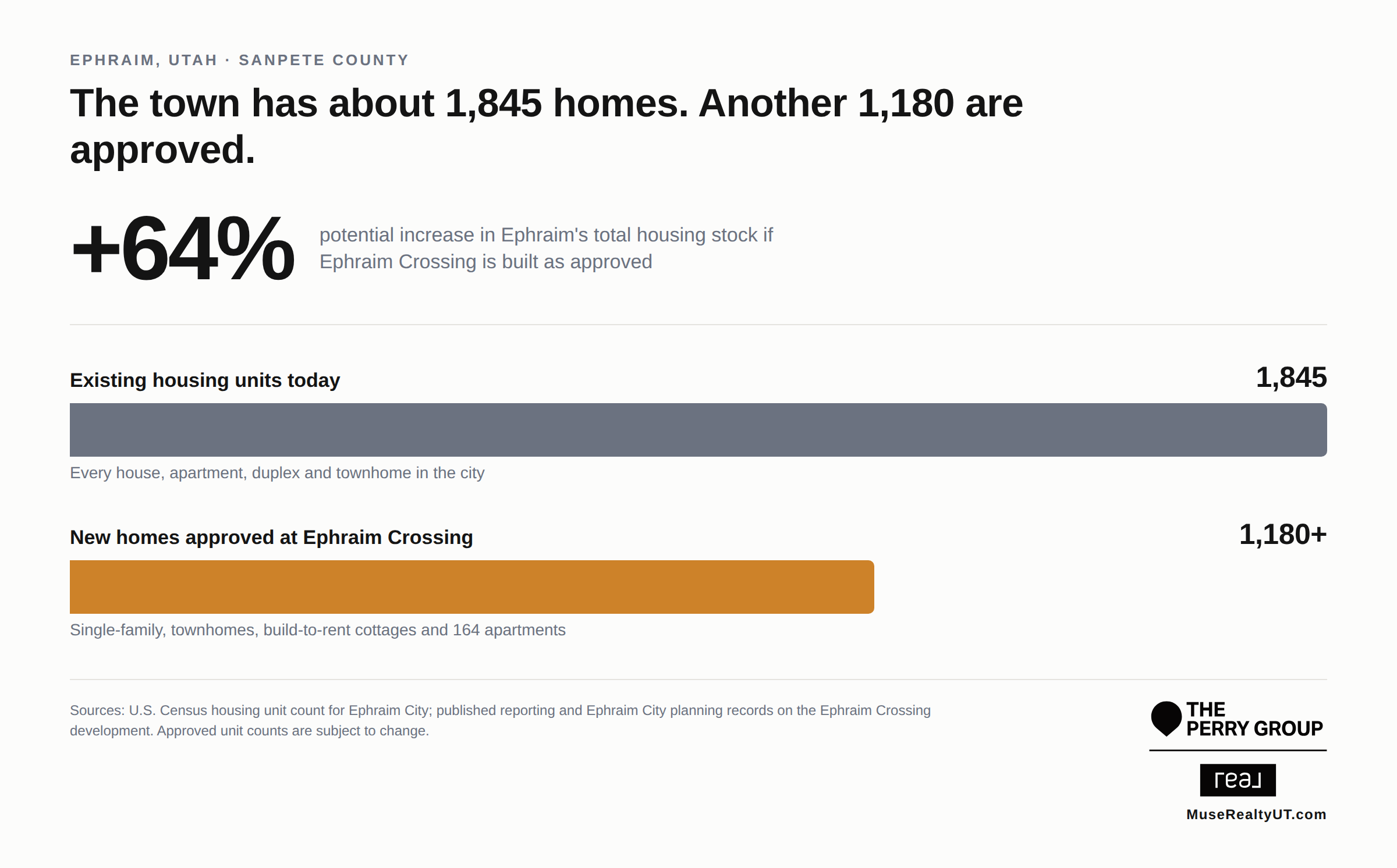 Ephraim has roughly 1,845 housing units. That’s the entire city — every house, apartment, duplex and townhome inside the limits, per the most recent census count.
What’s actually approved and moving
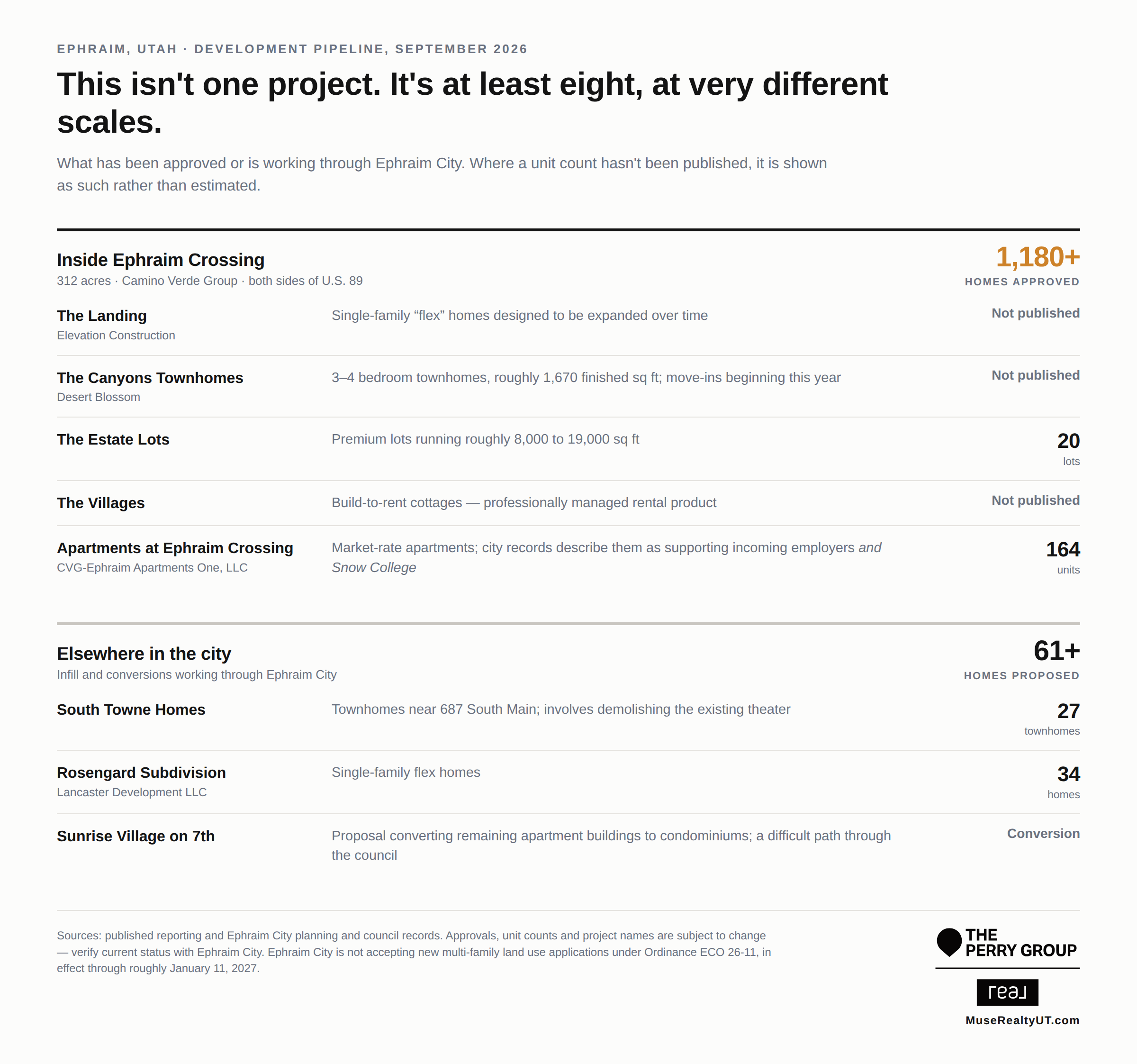
This is not one project. It’s at least six, at very different scales.
Ephraim Crossing is the anchor — 312 acres from Camino Verde Group, a Las Vegas developer, straddling both sides of U.S. 89 on the south end of town. Published reporting puts it at 1,180+ homes and more than $300 million in investment, alongside a 40-acre commercial town center, two hotels, 20+ acres of parks and trails, and significant industrial and retail space.
The anchors matter as much as the rooftops: a $100 million Intermountain Health facility and Soapcreek Manufacturing. Those bring payrolls, and payrolls bring renters who’ve never set foot in a Snow College classroom.
Inside Ephraim Crossing, several products are moving independently:
- The Landing — single-family “flex” homes designed to be expanded over time, built by Elevation Construction
- The Canyons Townhomes — 3–4 bedroom units around 1,670 finished square feet, Scandinavian-modern styling, with move-ins beginning this year
- The Estate Lots — 20 premium lots running roughly 8,000 to 19,000 square feet
- The Villages — build-to-rent cottages
- Apartments at Ephraim Crossing — 164 market-rate units, described in city records as intended to support workforces from incoming businesses and Snow College
Outside Ephraim Crossing, smaller infill has been working through the city:
- South Towne Homes — 27 townhomes proposed near 687 South Main, which involves demolishing the existing theater
- Rosengard Subdivision — 34 single-family flex homes from Lancaster Development
- Sunrise Village on 7th — a proposal converting remaining apartment buildings to condominiums, which has had a difficult path through the council
Ephraim isn’t adding housing at the margin. It’s being substantially rebuilt.
Then, in July, the city hit the brakes
Here’s the part almost nobody has connected.
While all of that was moving forward, Ephraim City stopped accepting new multi-family development applications. Every zone, citywide.
It wasn’t opposition to growth — the city had just spent two years approving more housing than it had in decades. Ordinance ECO 26-11 cites “a critical need to address the City’s water supply and development codes to address existing deficiencies,” noting that ongoing drought conditions supported pausing residential growth while the city evaluates future water demands.
Staff also flagged something quieter and arguably more consequential: the existing development code, written decades ago, permits densities misaligned with community expectations.
What’s frozen: all new building, development activity, and any land use application for a multi-family subdivision, in any zone.
What isn’t:
- Existing approved subdivisions continue
- Complete applications already in review continue
- Individual single-family homes on existing lots are unaffected
- Commercial development is unaffected
So if you own a lot and want to build a house, none of this touches you. The pause is aimed squarely at new multi-family.
It took effect July 15, 2026 and runs 180 days — to roughly January 11, 2027. Under Utah Code § 10-20-504 a city can only impose a temporary land use regulation for six months, and outside highway-corridor cases it can’t be extended. The city has to show a compelling public interest, meaning a substantial risk to public health, safety or welfare. Water supply during drought clears that bar without much argument.
Worth noting on fairness: state law would have allowed Ephraim to apply the freeze to pending applications, since applicants don’t gain vested rights against a temporary ordinance. The city chose to protect them anyway.
Why both facts matter at once
Read the second half of the city’s reasoning again — a code that allows densities misaligned with community expectations. That’s a city signalling it intends to permit less density going forward, not more.
Which means the near term and the long term point in opposite directions, and you need to hold both:
Near term — a supply surge. Roughly 1,180 approved units are coming, including build-to-rent cottages and 164 apartments aimed partly at Snow College. That’s professionally managed, brand-new rental product arriving at scale in a town with fewer than 1,900 total units today.
Long term — a tighter constraint. If the rewritten code reduces allowable density, Ephraim Crossing may be the last project of its size this town sees. Approved density becomes scarce, and what already exists gets harder to replicate.
And underneath both: water is the binding constraint on growth in this valley. Not demand, not land, not capital. A city that pauses development to count its water is telling you something about the next twenty years, and it applies well beyond Ephraim’s boundaries.
So what about buying a rental near Snow College?
Most of the logic holds up. Three things usually don’t.
You’re about to have institutional competition. If you buy an older three-bedroom near campus to rent to students, purpose-built rental product with on-site management and modern finishes is arriving within a couple of years. That doesn’t make a small rental a bad idea — plenty of tenants prefer a house to a complex — but the version of the math where rents drift upward because “there’s nothing else available” is not the market you’re buying into.
Summer is where college-town rental math dies. Snow College is primarily a two-year institution, so turnover runs faster than at a four-year school, and June through August is the most common place these deals come apart. Run the numbers at nine months of rent and at twelve, and be honest about which one your budget actually requires.
Check which campus you mean. Snow College operates two — the main campus in Ephraim, and a second in Richfield, about 35 minutes south in Sevier County. Different inventory, different price points, different rental dynamics. When someone tells me they want to buy “near Snow College,” that’s my first question, because it changes the entire analysis.
What I’d verify before writing an offer
- Rental rules for the specific parcel, not the general zoning. Overlay zones, licensing and occupancy limits vary by address. Ephraim City’s planning office is the right call.
- HOA restrictions on rentals — newer developments frequently cap what share of units may be rented.
- Whether the moratorium affects your plans. If you’re counting on adding units, converting a property, or building multi-family, you’re paused until January and should assume the rules change afterward.
- Nine-month and twelve-month scenarios, side by side.
- Your exit. Sanpete County resale is thinner than Utah County. Plan on holding longer, and price that in.
If you want a second opinion on a specific property
I work Sanpete County and southern Utah County, and I’m glad to sit down with the real numbers on something you’re considering — including telling you when a deal doesn’t work, which happens more often than the marketing suggests.
Whether it’s a rental, a house you’d live in while renting a room, or a place for a student in your family, get in touch and we’ll look at it properly. If you already own in the area and just want to know where you stand, start with a home valuation.
Robert Muse, REALTOR® · U.S. Marine Corps Veteran
The Perry Group | Real Broker, LLC
(385) 786-8381 · [email protected] · MuseRealtyUT.com
General market information, not investment, tax or legal advice. Development plans, approvals, zoning and city ordinances change frequently — verify current status directly with Ephraim City and your own advisors before making any purchase decision. I am not the listing agent or listing brokerage for any development named in this article. Header image is illustrative and does not depict a specific property, development or location named here.